
when misogyny wins
on Kenzaburo Oe's An Echo of Heaven, a book that is almost great

Hello readers, learners, and friends!
Initially I wrote a few paragraphs trying to establish that I don’t usually review books based on their gender politics and am in fact smarter than that. But I cut them because they were kind of stupid. I can review books however I want, and this particular book, An Echo of Heaven by Kenzaburo Oe (tr. Margaret Mistutani), fails on account of its particular approach to gender. I’d like to try and explain the precise cause of that failure, because I think it’s useful to situate the discussion of misogyny within the work itself, and the work’s attempt at the universal Truths of art. An Echo of Heaven is not the first or only book I’ve read that fails in this way, but it is the most recent, and I hope to make this a good illustration of how I think about this issue. And give the book its due - it does do some very interesting things!
I want to add just a bit of context, as this is a relatively unknown book1. Kenzaburo Oe is a Japanese Nobel laureate, awarded the prize in 1994, for his work creating “an imagined world where life and myth condense to form a disconcerting picture of the human predicament today”. He is best known for his writings about the atomic bomb, his political activism, and his literature inspired by the birth of his disabled son.
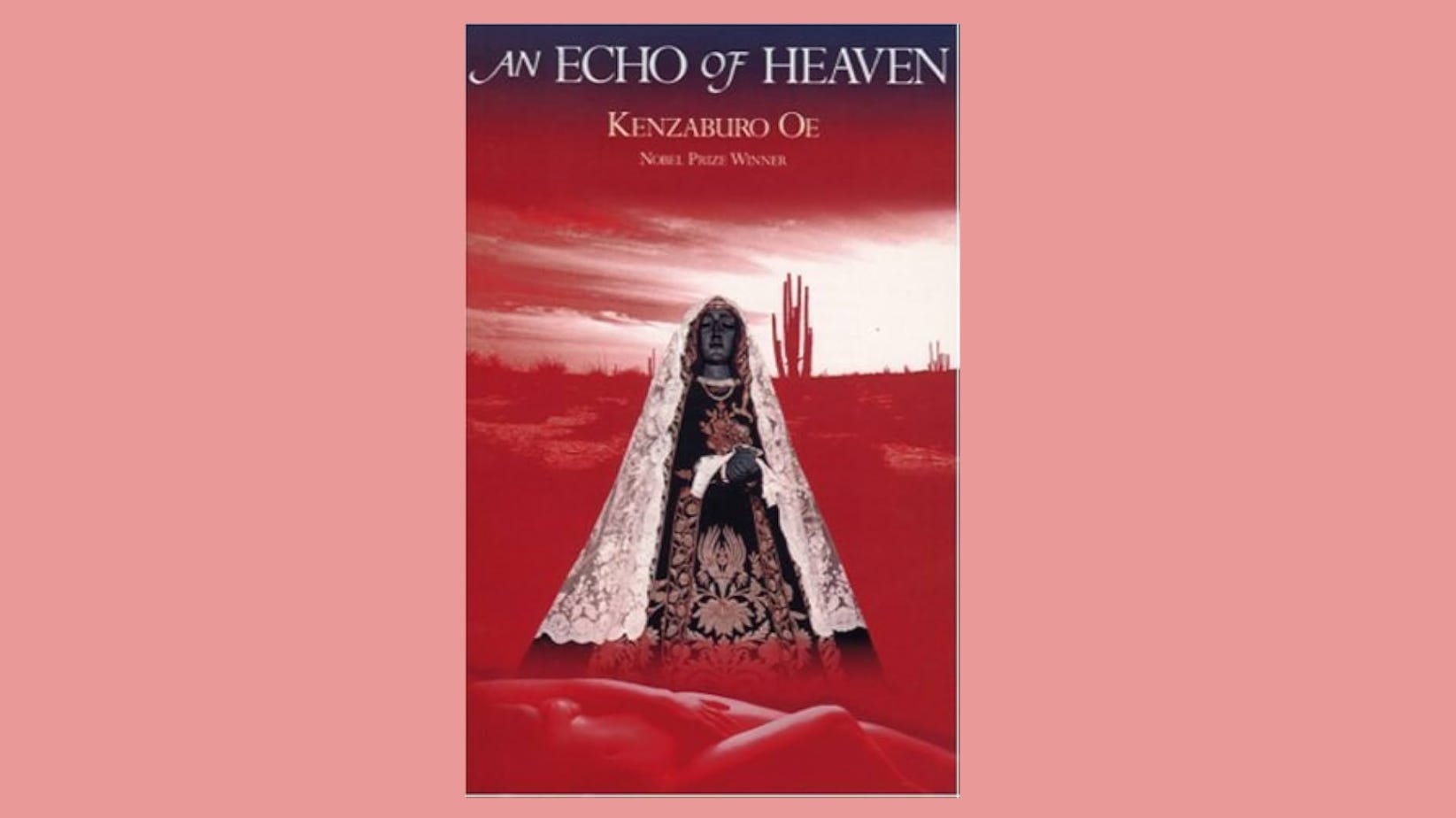
An Echo of Heaven was published in Japanese in 1989 and in English in 2000, and I picked it up at a secondhand store shortly after reading Ocean Vuong’s By The Book interview2 recommending another Oe book. My edition doesn’t have a blurb so I had literally no idea what this novel was about when I started, and I didn’t know anything about Oe other than his Nobel winner status, as noted on the cover of the book.
An Echo of Heaven is about Marie (pronounced Mah-ree-ay), a woman who is a friend of the narrator, a fictionalized version of Oe himself. Marie and K met through their sons, who both have a similar disability and love classical music. The frame story of the novel is that K has been asked by some friends of Marie’s to help write a movie about her life - this “novel” is meant to be the written source material they will rely on for the film.
The narrative itself begins at a protest, where Marie brings food and other supplies to the protesters camping out, including the narrator. Right away the gender roles are apparent, though not explicit: Marie is in a caring role, while the men are doing something significant. As the narrator’s relationship with Marie deepens, we see he is first drawn to her dedication to her disabled son, and then the way she is transformed by a tragedy affecting both of her children.
Oe is interested in exploring the transformation of a human being in the face of suffering, and the human response to evil. Marie is a scholar of Flannery O’Connor, and though I haven’t read O’Connor’s work, her thought is all over this novel. Marie has increasingly spiritual experiences, joining various religious groups and communes, though she consistently voices her own doubt in the existence of God. Through her actions and conversations, Marie is looking, though without much confidence, for the meaning in her suffering.
The narrator and the novel’s other characters confront Marie with their assumptions about her grief and how they believe she should react. However, Marie is a symbol, both in the eyes of the characters and in the structure of the novel itself. This is obvious right away from the frame story, about a group of men who want to make a film about her life. The other characters are unable to understand or make sense of the tragic events in her family, and though they care about Marie, they must flatten her to avoid inviting her void into their life. She is markedly set apart not just by unspeakable tragedy, but also by gender, as the one person who shares the experience, her ex-husband, and the father of her children is just as alienated from her reality.
Marie never finds meaning. Oe refuses to resolve this basic question so simply, and he is using her life to explore various ideas about going on in the face of incredible loss. What does happen with Marie is that she collects these hangers-on - the trio of college students, the American artist called Uncle Sam, the fellow members of a religious cult, a Japanese Mexican businessman turned farming commune founder, and the narrator himself. Marie is never able to “move on”, or transform what she has been through into something good for herself. Instead, she allows those around her to use her suffering in their own narrative-making, for their own spiritual ends, seemingly without complaint. The film, the novel, these characters’ preoccupation with her: it is a reflection of other people’s attempts to make sense of suffering. Marie’s gift to the world is her own transformation into a cipher - the loss of self that stemmed from the incident, taken to completion.
Nothing I’ve said so far would make this novel bad. A book about a woman, whose tragic loss shapes her life, who allows herself to become symbolic, and who is a novelistic excuse to explore the human response to evil sounds great to me. Sadly, Oe whiffs the landing by making Marie an object of sexual interest for the narrator. The effect of this is twofold: the things that preoccupy him about Marie are only sometimes the themes of the novel, and when they’re not, they’re things like her pubic hair; and the sexual tension adds another layer of abstraction to the portrait of Marie, already a saint, now also a whore.
This didn’t work in the novel not because it’s not realistic (it is), or because Marie shouldn’t have sexuality (she certainly should), or because men shouldn’t write fiction sexualizing women (it may not be to my taste, but it should exist and it can be great). It didn’t work because it plays such a large role and it’s mostly unexamined. Oe puts so much delicacy into the exploration of Marie’s inexplicable response to astounding tragedy. And yet this “biography” is narrated by a man, who is attracted to her, who tells us of her sex life, and who doesn’t bother to interrogate his own attraction. We understand why the events of Marie’s life make her significant, interesting. We don’t understand why the narrator’s Frida Kahlo-inspired sex dreams about her contribute to this significance.
I kept expecting Oe to link together Marie’s sexuality with the core themes - some joie de vivre when there’s nothing left to live for - but this was only ever treated cursorily. Because Marie is made symbolic, there could have been space for an interrogation of that eternal feminine duality: purity or depravity. Instead, the narrator’s sexual interest is taken as natural, as though it entitles him to the claim of intimacy to write this book. It’s a story about a woman made into a symbol, seemingly unaware of its own gendered flattening of Marie.
This book did a lot of things right, and I’d like to read another Oe work. However, the reductive and predictable way Marie was treated as an object of male sexual desire attenuated the impact this work should have had, and made me roll my eyes and sigh several times. I probably wouldn’t recommend this, but don’t let me put you off this author all together.
Thanks for being here!
At least in the English speaking world, where I assume all of you are.
I love the By The Book interviews for getting really great, interesting and under-the-radar book recommendations. The best interviewees for this series are always a surprise to me - their recommendation quality doesn’t seem to correlate in any way with their writing skill.